
written by: Fransiskus Paranso (CPO)
Executive Summary
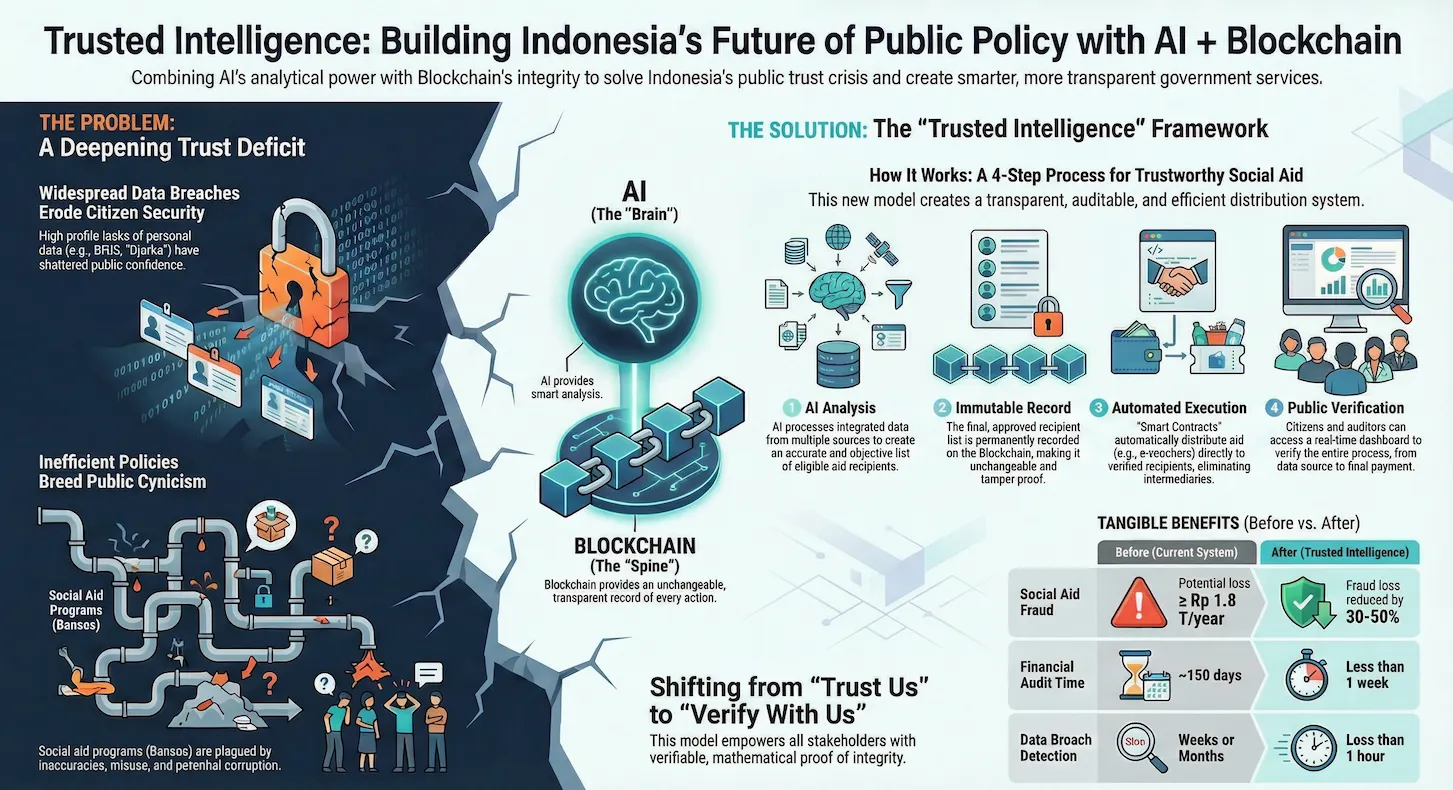
Trusted Intelligence addresses the crisis of trust and policy inefficiency by integrating Artificial Intelligence (AI) and Blockchain. Within this ecosystem, AI acts as the “brain” that analyzes data to support precise decision-making, while Blockchain serves as the “backbone” that records every transaction permanently and transparently. This synergy enables automated execution through smart contracts, reducing bureaucratic complexity, preventing corruption, and potentially saving trillions of rupiah in public spending annually. The paradigm shifts public services from a “Trust Us” model to a “Verify with Us” model, ensuring policies that are intelligent, secure, transparent, and auditable in real time.
- The Trust Crisis in Indonesia’s Digital Era
Indonesia is currently navigating an inevitable wave of digital transformation. Driven by demographic advantages, massive internet penetration, and accelerated significantly by the COVID-19 pandemic, digitalization has reached nearly every aspect of public and governmental life. The government has responded through ambitious initiatives such as the Electronic-Based Government System (SPBE) and the One Data Indonesia program, all aimed at creating a government that is more efficient, transparent, and responsive to citizens’ needs. The vision is clear: data should become the foundation of intelligent policymaking, while technology should serve as an accelerator of public service excellence.
However, beneath this optimistic narrative lies a growing and fundamental challenge: a crisis of trust. Ironically, technologies that were intended to strengthen trust have also introduced new vulnerabilities. Data, often described as the “new oil” of development, has simultaneously become one of the greatest sources of public anxiety and one of the government’s most significant challenges. This crisis rests on two interconnected and fragile pillars.
Pillar One: Erosion of Trust Due to Data Vulnerabilities and Cybersecurity Risks. A series of large-scale data breaches in recent years has significantly undermined public confidence. Incidents involving alleged leaks of population records, SIM card registration data, healthcare records, and the widely publicized “Bjorka” case—which claimed access to data from strategic government institutions—have raised serious concerns regarding the government’s ability to safeguard citizen data. These incidents have delivered a troubling message to the public: personal information entrusted to the state for public services may no longer be secure. As a result, public confidence in the government’s role as a trustworthy custodian of data has reached a critical low point.
Pillar Two: Erosion of Trust Due to Policy Inefficiency and Misconduct. Public trust is also weakened by inefficiencies and misconduct in policy implementation. Critical programs such as social assistance distribution (Bansos) continue to face longstanding challenges, including inaccurate beneficiary databases, targeting errors, and corruption cases that have resulted in significant financial losses to the state. Citizens repeatedly witness how well-intentioned policies become distorted during implementation. This has fueled public cynicism and apathy, creating a perception that existing systems are unfair, opaque, and difficult to audit independently.
The Trust Deficit Cycle. Together, these two pillars create a vicious cycle of trust deficit. On one hand, citizens hesitate to provide their data due to concerns about misuse or data breaches. On the other hand, without accurate and reliable data, governments struggle to design and implement effective policies. Consequently, costs associated with verification, auditing, and oversight continue to increase, while policy outcomes become less effective and government legitimacy gradually erodes.
Indonesia now stands at a crossroads. Continuing with conventional digitalization—focusing solely on digitizing processes without establishing a robust trust foundation—will only deepen the crisis. Returning to an analog era is not a viable option. Therefore, Indonesia requires a paradigm shift. Rather than merely using technology, we must embed trust directly into technological architecture through a Trust by Design approach. The critical question is no longer: “How do we secure data?” Instead, it becomes: “How do we create an ecosystem where every piece of data and every transaction can be independently verified by authorized parties at any time, without relying on expensive and vulnerable intermediaries?” The answer lies in a framework we call Trusted Intelligence.
- Trusted Intelligence Concept
Addressing a trust crisis of this magnitude requires more than incremental improvements. Indonesia needs a new paradigm for designing and managing public policy in the digital age. Trusted Intelligence is a strategic and technical framework that fundamentally integrates two transformative technologies: Artificial Intelligence (AI) and Blockchain
This is not a random combination. Rather, it is a deliberate partnership in which each technology compensates for the other’s weaknesses, creating a system that is both intelligent and inherently trustworthy.
Using a human-body analogy:
- AI as the Brain
AI processes vast amounts of complex information, learns from patterns, generates predictions, and recommends optimal decisions. It provides intelligence to the system.
- Blockchain as the Spine and Nervous System
Blockchain provides a strong, immutable, and transparent structure that records every decision and transaction. It ensures that instructions generated by the “brain” are faithfully recorded, transmitted, and protected from manipulation. It provides integrity and trust.
The Role of AI: Creating Intelligent Policies
Within the Trusted Intelligence framework, AI transforms fragmented and chaotic data into actionable insights. Using data from sources such as: Social Welfare Integrated Data (DTKS), Population registries, Electricity consumption records, Satellite imagery, Other government databases. AI can:
- Improve Targeting Accuracy: AI can generate dynamic eligibility scores for social assistance recipients, significantly reducing inclusion and exclusion errors.
- Detect Anomalies and Fraud: AI algorithms can identify suspicious transaction patterns in real time, uncovering irregularities that may escape manual monitoring.
- Optimize Resource Allocation: AI can forecast regional service needs, enabling more efficient budgeting and logistics planning.
In short, AI transforms government from reactive to proactive and from one-size-fits-all policies to personalized and precision-driven governance.
The Role of Blockchain: Building Verifiable Trust
No matter how powerful AI becomes, it still faces inherent limitations. AI often operates as a “black box,” and its outputs are only as reliable as the quality of its input data. Blockchain addresses this challenge by providing a trust foundation.
Its key functions include:
- Immutable Audit Trails: Every AI-generated decision, budget allocation, and public transaction is recorded as an encrypted and interconnected transaction block. These records cannot be altered, deleted, or repudiated.
- Controlled Transparency: Authorized institutions such as the Supreme Audit Agency (BPK), the Corruption Eradication Commission (KPK), and other oversight bodies can verify processes without modifying the underlying data. Citizens may also independently verify service outcomes related to their rights.
- Smart Contract Automation: Policy rules can be programmed directly into smart contracts. For example: “IF a citizen’s National Identity Number (NIK) is verified by the AI system as eligible for assistance AND budget allocation is approved, THEN automatically transfer a digital voucher worth Rp X to the citizen’s digital wallet.” This removes unnecessary intermediaries, reduces bureaucracy, and minimizes opportunities for corruption.
The Golden Synergy: Why AI and Blockchain Are Stronger Together
The true strength of Trusted Intelligence lies in the mutual reinforcement between AI and Blockchain.
- Blockchain Tames AI
By recording AI inputs, models, and outputs on an immutable ledger, Blockchain mitigates AI’s black-box problem and creates accountability.
- AI Cleans Data for Blockchain
AI ensures that only verified, high-quality, and trustworthy data is permanently recorded on Blockchain, preventing the classic “garbage in, garbage out” problem.
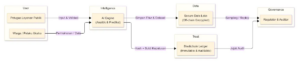
Together, they transform the relationship between government and citizens. The model evolves from: “Trust Us” to “Verify with Us.” This creates public services that are not only efficient and effective but also transparent, auditable, and mathematically accountable.
- Trusted Intelligence in Action
Core Analogy: Analytical Intelligence and Transparent Recording
Imagine a process involving two key actors:
- The Analytical Intelligence (AI): A system capable of analyzing vast amounts of information and generating optimal recommendations.
- The Transparent Recorder (Blockchain): A system that, Records approved decisions permanently, Applies, cryptographic validation, Executes predefined actions automatically through smart contracts, AI provides intelligent recommendations. Blockchain guarantees execution integrity. Together, they ensure both accurate decisions and trustworthy implementation.
Case Study: Social Assistance Distribution
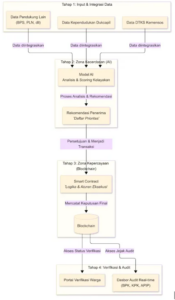
- Data Integration: Government databases are consolidated into a unified citizen profile.
- AI Analysis: AI evaluates eligibility using multiple indicators and produces a recommended beneficiary list.
- Human Approval: Authorized officials review and approve recommendations.
- Blockchain Recording: The final beneficiary list is permanently recorded on Blockchain.
- Smart Contract Execution: Assistance funds or vouchers are automatically distributed to eligible recipients.
- Verification and Audit: Auditors can monitor the entire process in real time. Citizens can independently verify their eligibility and benefit status. The result is a system that is intelligent, transparent, fast, and accountable.
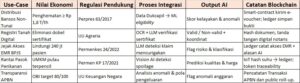
Example Use-Case Indonesia for Trusted Intelligence
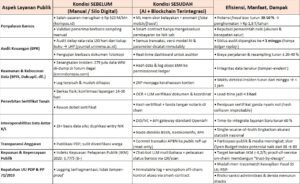
When we talk about digital transformation, the question we inevitably end up asking is: “What’s in it for the citizens?” Well, Trusted Intelligence is not just another technology gimmick project. Its impact is significant for both the state budget and social justice. Below are several examples of use cases that could be supported by the Trusted Intelligence concept.
Benefits and Impact
We are often skeptical about government technology projects, aren’t we? But Trusted Intelligence is different. This is not merely about replacing paper with applications; it is about genuinely saving public money. Imagine this: with this system, potential leakage in social assistance budgets could be reduced by more than IDR 1.8 trillion per year. Why? Because there is a “robot police officer” called a Smart Contract that will only release funds when the data is valid. As a result, there will be no more stories of mistargeted assistance or funds being “cut” along the way.
Below are several examples of the potential benefits and impacts that can be achieved through Trusted Intelligence.
Technology Choices
When we talk about adopting technology for a nation, we are not choosing a one-size-fits-all solution. Within the Trusted Intelligence architecture, local wisdom in data management becomes a key principle. We carefully distinguish between which areas are “private rooms” that must be strictly protected and which are “front yards” that everyone should be allowed to see. For matters concerning citizens’ livelihoods and privacy—such as social assistance recipient data, electronic medical records (EMR), or land certificates—the state cannot compromise. This is where we use a Permissioned or Consortium Blockchain approach.
Imagine it as a restricted meeting room where the keys are held only by an alliance of ministries and government institutions. The infrastructure remains decentralized so that no single party can manipulate the data at will. We gain the benefits of technological security without sacrificing data sovereignty. However, for matters that require absolute public trust, such as transparency in state budget spending or e-voting results, we must be willing to be more open. This is where we utilize a Public Network.
In this zone, transparency is king. Citizens, the media, and independent watchdogs are welcome to “peek into” the nation’s ledger in real time. It may sound like a utopia, but if we truly want to make this country better, there is nothing wrong with trying. Through this hybrid strategy, the government not only appears technologically advanced but also demonstrates wisdom. We protect what must be protected and open what the public has the right to know.
That is what true technological balance looks like.

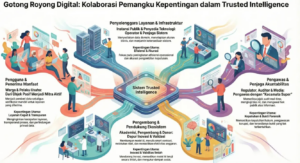
Stakeholders
Building a Trusted Intelligence system is like organizing a grand concert. We cannot rely on a single performer. No matter how sophisticated the technology is, it will fail without human collaboration. This is where the concept of “Digital Gotong Royong”—or a multi-stakeholder coalition—becomes the lifeblood of the entire ecosystem. Within this ecosystem, the government no longer works alone in isolation.
The government acts as the conductor, setting the rhythm and defining the rules of the game. Meanwhile, stakeholders from the private sector and academia serve as the “innovation kitchen,” ensuring that the AI “brain” we deploy remains intelligent, unbiased, and scientifically validated. Yet the most interesting transformation occurs among citizens themselves. Citizens are no longer positioned merely as passive recipients of public services. Instead, they are elevated into active partners who can independently verify services—checking whether their rights have been fulfilled—directly through Blockchain transparency.
Risks & Mitigation
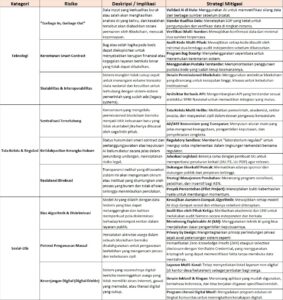
Let’s be honest: there is no technology that works like a magic wand, including Trusted Intelligence.
Behind its impressive potential lie risks that, if ignored, could become a double-edged sword for the nation. There is the classic “Garbage In, Garbage Out” problem. If the data fed into the AI “brain” is dirty or biased, Blockchain will merely function as a photocopy machine that preserves those mistakes forever.
There are also technical challenges such as smart contract vulnerabilities and regulatory frameworks that may not yet be prepared to keep pace with such rapid change. However, the greatest threat may not lie in the technology itself, but in its impact on people. There are concerns regarding algorithmic bias that could discriminate against vulnerable groups, as well as the risk of widening the digital divide, which may further marginalize citizens who do not yet have access to the internet or advanced digital devices.
Therefore, mitigation strategies are not optional additions—they are fundamental safeguards. We must prepare multiple layers of protection: from rigorous code audits and regulatory sandboxes for safe experimentation to commitments for hybrid service delivery (both digital and manual), ensuring that no citizen is left behind. Innovation requires the courage to move forward, but that courage must be accompanied by measured vigilance.
The following matrix outlines several risks that should be mitigated before adopting the Trusted Intelligence concept.
Key Takeaways
Let us pause for a moment and look honestly into the mirror of our nation’s reality. We are running rapidly toward digital transformation, but the question remains: Are we running in the right direction, or are we simply transferring the tangled threads of bureaucracy and corruption from paper into applications? Or worse, are we creating applications that become new avenues for corruption?
If digital transformation merely means creating applications without fixing the foundation of trust, then we are not creating solutions. We are simply engaging in the “Digitalization of Problems.” Data breaches, mistargeted social assistance, and disappearing budgets are no longer merely technical mistakes. They are signals that our systems are fragile and directionless.
The choice is ours today: Remain with the old way of doing things, or dare to leap into Trusted Intelligence. A future where the intelligence of AI is combined with the uncompromising honesty of Blockchain. A future where systems possess a smart “brain” to serve citizens, but also a strong “backbone” that stands upright and cannot be bribed.
Indonesia’s future can no longer be built on the slogan: “Trust Us.” That era is over. The new era demands a different paradigm: “Verify with Us.” Citizens have the right to know. Citizens have the right to verify. Citizens have the right to obtain mathematical proof that their rights are secure—not merely sweet promises from those operating the system today. Remember: no matter how advanced technology becomes, it remains nothing more than a lifeless tool without purpose and values.